Natural Solutions: Improving Sleep

Natural Solutions: Improving Sleep

  1. Natural Solutions: Improving Sleep


    If you are getting less sleep because of your lifestyle or any other reason, then you are not the only person! Although it is recommended that you should get seven to nine hours of sleep daily, sometimes, all of us fall short on that count. For some of us, it is the stress or failure to switch off, while for some more serious ailments like insomnia might be the cause. Whatever be the cause, there are ways to improve sleep naturally.

    So, if you are on the lookout for some natural solutions for improving your sleep, here are some ways in which you can do that.

    #1: Aromatherapy

    You might have heard of aromatherapy as a way to induce sleep, but have you tried it? You should try out lavender as it is well known to aid sleep. In addition, it is not too costly, and comes without any side effects. All you would need is a proper diffuser. You can even find a spray with lavender and use it on your pillow before sleep.

    #2: Meditation

    Before you go to bed, try meditation. If you find it hard to concentrate, just close your eyes, focus on breathing and relax. That way, you would be able to relieve the stress before you drop off in bed and clear your mind a little. If you find the silence intimidating, you can also put in some soft music in the background, which will calm your nerves, as well as help you relax.

    #3: Green Tea

    Green tea consists of an amino acid named L – theanine, which helps you relax during the night. It is the same protein which keeps you healthy and alert during the day. However, while consuming green tea at night, make sure that you don’t overdo it. Recommended dose for proper sleep is around 50 – 200 mg. Also, refrain from caffeine at night, especially before or after dinner if you would love to have some hours of extra sleep.

    #4: Steam Saunas

    Steam saunas are yet another effective way of treating insomnia. The heat from the saunas not only helps to relax your nerves, but also softens your muscles. This helps you get rid of pain, and relieves tension from your body. Additionally, if you take steam saunas regularly, you can also get rid of stress, arthritis aches, migraines and headaches. It also makes you become more efficient by helping you to get rid of tiredness. One of the key benefits of steam saunas is that it helps your body get rid of toxins, which in turn helps you be healthy but the comforting state is great to bring on a good night’s sleep.

    #5: Feng Shui

    Feng and Shui in Chinese means air and water. Depending on the alignment of your bedroom, and the ventilation, your sleep patterns can change. So, if you are having trouble getting some sleep, get your house checked by a Feng Shui expert or get yourself a guidebook. Some of the easiest way of adjusting your bedroom according to Feng Shui would be

    • Keeping your bed easily approachable from all sides
    • Keeping the windows open and air in the room fresh
    • Maintaining a clean room, without trash and clutter, which might stress you out

    #6: Acupuncture

    Acupuncture is one of the traditional Chinese methods for treating insomnia. Acupuncture works by stimulating certain points on your body for healing. These acupressure points correct the energy balance in your body by opening up blocked channels (meridians). Additionally, acupuncture also causes the secretion of chemicals like melatonin and tryptophan, both of which help you to sleep.

    #7: Proper Schedule

    When it comes to sleep, you need to have a proper schedule for sleeping. This is true in case of not only sleep, but also overall maintenance of your health. For example, if you exercise for a day, and then stop, you would not see any changes. However, if you repeat the exercise daily for half an hour, after a week, you might see some progress. This is why, it is important to stick to a schedule. It also helps your body clock to know that it is time for sleep. In order to help yourself relax before sleep, you can also try drinking a warm glass of milk, or listening to music. This also helps you to establish a routine, and prepare your mind ahead of sleeping by giving it a step by step routine.

    #8: Exercise

    Exercising daily provides you with a better sleep. It also provides you with a healthy lifestyle, and more energy than you normally have. However, you need to stick to a regular exercise regimen and not wear yourself out in a day. In addition, do take care of your diets before and after exercising.

    These are only some of the natural ways in which you can get rid of insomnia. While treating insomnia, you also need to focus on your food and lifestyle, in addition to getting alternative treatments. At the end of the day, it is always better to stay away from prescription drugs for sleeping, and these natural methods would help you to do so!

    Thank you to Nina Wells who wrote this article. Nina is a guest author from Steam Shower Store and is a respected and expert voice in a plethora of health related subjects with over 10 years of writing under her belt.

Mind Over Matter: How You Can Beat Shopping Addiction

Mind Over Matter: How You Can Beat Shopping Addiction

Mind Over Matter: How You Can Beat Shopping Addiction

Article from Gemma Fallon

Living beyond ones means is surprisingly common. With the advent of home shopping catalogs, ‘buy now, pay later’ offers, store cards and credit cards, it can be hard to resist. Time magazine suggested that due to today’s culture of borrowing, each American citizen has accumulated around $10,000 of debt.

There is no harm in spending if you can afford it and everyone likes to splash out on material things occasionally. The problem occurs when the shopping trips get too frequent and too much capital is being spent on unneeded items while bills aren’t paid and the bank account is in the red. According to a Stanford University study, 17 million people in America have exactly this problem!

If you think your spending is getting out of control, you feel you ‘have’ to shop whenever you go out, you keep repeat buying things you don’t need, you’re hiding your purchases or your credit card bills from your partner or your shopping habits are starting to cause arguments between you, you could be affected by shopping addiction.

Why Conventional Treatments Don’t Always Work

The standard medical response to over spending and shopping addiction is drug therapy – either anti-anxiety or anti-depressant medication. This is because most of those affected by a compulsion to over spend have low self-esteem, are anxious or have depression. The trouble with this approach is that it only moderates or masks the symptoms of emotional illness and doesn’t do anything to fix the reason why the person is stressed in the first place. It is also well known that people who compulsively buy are more likely to have other addictions including prescription medication addiction. Over spending tends to run in families who commonly deal with other disorders. Using drug therapy to treat a ‘shopaholic’ may simply swap one ‘fix’ for another.

Some counseling approaches focus on not doing the undesirable behavior. This can help but can also have the same effect as going on a diet. If a person gives up cake, they may crave it even more.

Looking at What’s Really Going On

The secret to changing behavior in the long term is to address why you want to shop. Are you shopping because you’re lonely or bored and unfulfilled? Getting out there and hitting the town means that you are mixing with other people. Buying new things like clothes and accessories can also help you to feel better about yourself and have more confidence. Having distant parents during childhood, going through divorce and dealing with single parenthood are some of the common reasons for low self regard.

The act of purchasing items stimulates the body to produce endorphins – pain killing ‘feel good’ hormones – and dopamine, a neurotransmitter associated with rewards. This combination can be addictive, particularly in people who are stressed as it is a welcome relief. However, this physiological response is always short lived, leading the person to repeat the behavior to achieve the same feeling.

Identifying whether you are lonely, insecure or depressed and working to heal from those emotional issues so you no longer feel the need to over spend offers better prospects for long term healing.  For instance, you could change your job, start a new evening class or join a gym. These offer relief from boredom and open up the opportunity for meeting new friends without spending large amounts of cash.

Heal Yourself with the Emotional Freedom Technique

You can beat your addiction and begin a new and positive phase of your life with the emotional freedom technique (EFT). EFT is a form of acupressure and energy psychology that has the same basis as acupuncture but without the needles. By tapping at various meridian points on the body, while thinking or voicing a positive thought, you can redirect negative energy, improve your outlook and even begin to heal from physical ailments. Blocked energy is forced to move and flow more freely. This, coupled with positive affirmations can alter your mood for the better and imbue you with confidence that doesn’t fade.
Psychological research into the clinical value of EFT has found that it can be helpful in restoring positive feelings in strained relationships, lessen the likelihood of addictive patterns of behavior and assist in the tackling of existing addictions.
EFT is self-administered and can be performed whenever you feel the urge to get out your credit card.

Positive visualization, combined with EFT, can also help correct unwanted behaviors so it can be used to stop compulsive shopping.  Imagining how you would like to respond to the temptation to shop can re-train your brain to react in a different way so you can control your impulses instead of them controlling you.

Life Coaching

A effective method of counseling that you can use with EFT is life coaching. Instead of traditional ‘talk’therapies that focus on problems and what you have done ‘wrong’, life coaching focuses on how you would like to live your life and provides tasks that you can do to improve your life so that you can become proactive in your own self-improvement.

Holistic Harmony run seminars and provide books about EFT, energy psychology, life coaching and reclaiming your life. For more information and help with treating addictions, we would be happy to hear from you.

The Role of Emotional Stress in the Development of Illness

The Role of Emotional Stress in the Development of Illness

The Role of Emotional Stress in the Development of Illness

Article from Gemma Fallon

Modern medicine provides outstanding care when it comes to advanced pain relief, surgery and life saving intensive care support, but has been rather slow to catch up with what alternative therapists have been saying for decades: the mind and the body are one and in order to attain full and vibrant health, the person must be treated on a holistic ‘whole body’ level. This may be why pharmaceutical medicines are effective at easing or stopping symptoms and giving the appearance of wellness but not so good at bringing about a permanent cure. They modulate the symptoms that are only an expression of disease, often without getting to the root cause of the problem.

Anxiety Increases Inflammation and Causes Depression

The field of psychosomatic medicine is beginning to catch on to holistic principle and in 2014 doctors discovered a key link between the mind and the immune system when they identified an inflammatory response from the immune system with an increased risk of developing depression. Inflammation is a normal, healthy response to illness or injury, caused by white blood cells rushing to the affected site to kill off pathogens or assist in the healing process. This rush of cells causes the characteristic redness and swelling associated with inflammation. There are trace amounts of inflammatory proteins in the body even when the person is well.

Scientists from the University of Cambridge in the UK followed 4,500 children of the 90’s – taking blood tests at age nine and again at age 18 to see what level of inflammatory markers they had. The young people with the highest amount were almost two times more likely to have had depression or psychosis compared with those who had only a small amount. The same research suggested that a hypersensitive inflammatory response from the immune system may be a cause for coronary heart disease and type 2 diabetes.

The lead researcher, Peter Jones, suggested that early life adversity and stress leads to a increase in inflammatory markers and influences physical and mental health – making a person more susceptible to chronic illness.

Mind/Body Illnesses

Some other illnesses now known to have a link with emotions include:

Tako-Tsubo cardiomyopathy – TTC,  heart condition in which the left ventricular wall doesn’t have correct motion, causing symptoms similar to that of coronary heart disease. This is sometimes called Stress Induced Cardiomyopathy or Broken Heart Disease because it has a direct link to psychological distress. BMC Cardiovascular Disorders feature the case of a woman who developed TTC after a miscarriage and the premature birth of a daughter.

Joint Hypermobility – Joint hypermobility is genetically inheritable but seems to be triggered by stress in those who carry the gene. Anxiety causes the abnormal formation of collagen.

Recurrent Chronic Cystitis – Doctors are increasingly realising that recurrent inflammation of the bladder is the result of emotions affecting the brain and hormone regulation. A case report of one middle aged woman with chronic cystitis detailed how she was successfully cured with a mind-body approach to her treatment.

Skin Diseases – Diseases like rhinovirus and Coxsackie virus are more severe if the person is stressed. Stress is also thought to have an impact in the development of allergic dermatitis, psoriasis and even skin cancer.

Did you know, cancer spreads faster if you think negatively?

Headaches and Migraine – People who have high levels of stress are more likely to have headaches or migraines. They also have a higher chance of gastrointestinal symptoms and musculoskeletal pain. Highly stressed women tend to have frequent infections.

Think Yourself Well!

Just as illnesses can be triggered by emotional states, they can also be cured by them. By replacing negative thoughts with positive ones and changing old thought patterns. Energy psychology is a great way to do this.
Energy psychology offers an easy way to take control of negative thoughts and improve health in simple steps:

1. Focus on the problem or the situation that causes anxiety and then purposefully bring to mind alternative, positive affirmations regarding the situation or life in general. Saying regular daily affirmations or writing them down in a book can have a wonderful, empowering effect on mind and body. The most famous example of a person who did this was Louise Hay, an American woman with a history of abuse who cured herself of vaginal cancer by positive thought.

2. Focus on the situation that causes anxiety and then use an acupressure technique to re-direct negative energy, forcing it to change so that the anxiety symptoms are also forced to change. This can be done by tapping on specific acupuncture points that correspond to the area of the body that is manifesting illness. Changing the energy pattern can change the behavior pattern that also changes the illness pattern.

3. Mindful, focused breathing can be done and will similarly alter negative energy flows so the person feels more centred and calm. This is a form of mindful meditation in which relaxation and controlled breathing help to de-stress the individual, as well as oxygenating their brain and bringing about an altered state of consciousness that is highly aware and more objective. Apart from providing an opportunity for the person to remove themselves from the daily stresses of life, it could assist them in finding solutions to problems or developing a new outlook.

4. Focusing on the good stuff. It sounds simple, but replacing negativity with thoughts of the people and things that are enjoyed, can bring powerful changes. Some people like to write in a ‘Gratitude Journal’, that is, a book where they can record the things they are grateful for each day.

For more information about how you can heal yourself and reduce pain with energy psychology, contact us about our range of books and seminars.

Ho’oponopono

Ho’oponopono

Ho’oponopono and how to Transform our Reality by Purifying Ourselves 


The ancient Hawaiian healing technique called Ho’oponopono asks us to take 100% responsibility for whatever appears in our reality – for whatever we perceive or comes to our attention. In this process we cleanse ourselves and our personal input into what we call, “our reality”, which is personal, communal and planetary. We change the world by changing ourselves. It is simultaneously a method for solving problems and for healing ourselves and others as well as situations. It is also a means for spiritual development and enlightenment.

The process is simple:


1. We realize or remember that whatever we are observing or is affecting us in any way is there because it is reflecting something within ourselves – mainly our personal memories, beliefs, emotions and programming.


We are attracting that specific reality because it is time to clean a certain part of ourselves that is contributing to it and actually co-creating it in some way. The specific reality might be persons or situations that seem to be not well – not harmonious. Or it could be something that bothers us personally – such as someone’s behavior or a world situation.


2. Having taken responsibility for the reality before us, we now we ask that person, situation or attribute for forgiveness for our participation in that specific reality that has come into our awareness.


Instead of asking for forgiveness we can simply acknowledge that we are participants in creating this reality.


Another option would be to thank the person or situation for the opportunity for self-knowledge and growth that it has offered us until now.


Note: It is highly unlikely that we will understand what our “contribution” to this is. It could be from our deep subconscious or even deeper dimensions of ourselves that we are not aware of. The “cause within us” may be as simple as the fact that we are unable to perceive the Divine in ourselves or others, or in what is happening, and thus are allowing whatever it is to annoy us.


3. We then feel and express our love to “that” which was bothering us or seems to be “not well or harmonious”. When doing so, we seek to feel acceptance, love, unity and good wishes for that person, event or situation.


4. We then need to feel love and acceptance towards ourselves as we are and let go of any guilt or self-condemnation with regards to this or any other reason.


5. Then we release the person, situation or event – whatever is bothering us – from the need to be that way any more for our evolutionary process. We give it permission to change.


6. Then we thank the Divine for dissolving these unenlightened memories, tendencies, fears and beliefs into the light of pure divine consciousness – which is actually their original state.


If possible, we can then remain some time in a state of emptiness or inner light as we allow the Divine to cleanse us of anything that might be attracting this undesired reality.


One hundred percent responsibility ???


This concept of responsibility is quite difficult for most of us to digest. Can we take responsibility for other people’s irresponsible or unethical actions? How can we be responsible for those who are abusing women and children or killing innocent persons in Iraq, Africa or elsewhere? Can we take responsibility for terrorist acts around the world? Such reactions naturally come to mind when we are asked to believe and employ this revolutionary system.


How can we be responsible for what “we” have not done and for what we would “probably” (we will never know until we find ourselves in the same circumstances) never do? How can we be responsible for what others are doing on the other side of the world and for situations perpetuated by leaders that we never voted for, do not agree with and even condemn?


Also how do we reconcile this truth with another equally obvious and valid truth that each of us is the exclusive creator of his or her reality and that others do not create our reality and we do not create theirs. These truths seem to be irreconcilable.


And yet, millions have found Ho’oponopono to be a really superb technique that leads ultimately to purity, love and freedom from negativity. But, even more impressively, it actually does change the external world.


Let us play with ideas that may help understand how it might work.


Our Collective Unconscious


We have many common emotions, beliefs and modes of functioning as hypothesized by Carl Jung in his theory of the Collective Unconscious. We share many programmings, fears, emotions and desires. It may just be that we are all affected by each other’s subconscious. Many experiments today are showing that we can be affected by what others are feeling, even though consciously we are not aware of what is happening. This is especially true of people with whom we are closely emotionally bound.


Quantum Physics has shown that the same is true of particles that have been in contact at some point in their history. Whatever happens to the one immediately affects the other.


Psychologists are also aware of the “connected container effect,” which speculates that people are like two containers with water connected by a pipe at their base. When we suppress the water in one container, it will rise in the other. It is well know that in a marital or family situation, one person’s suppressed emotions are communicated and often expressed by other members. Whatever we do to our own “water system” will affect the others who are connected to us in this way. We are affecting others by our invisible emotional connections to them.


Social paradigms


We are also affected by and participate in the common social paradigms into which we are born and raised. When we accept and act according to these paradigms, we are augmenting them for everyone else. Thus we are supporting others’ belief systems by allowing ourselves to be limited by those belief systems. If we believe that those who are different from us (race, religion, social class) are a danger to us, then we are co-creating that reality. If we believe there is not enough for all of us, we are co-creating that reality. If we believe that life is difficult and people are not to be trusted, we are contributing to those realities.


Our common morphogenetic field


Biologist Rupert Sheldrake’s theory of the morphogenetic field adds a biological dimension to this. He believes that our bodies and minds get their information from a common pool of knowledge and tendencies that exist in a field commonly accessible to us all. When any one of us makes a change in lifestyle, emotions or ways of thinking, those changes affect to some degree the state of our commonly shared field and that makes this new way of thinking or reacting more available and more possible to all others sharing that field. This works for all emotions, beliefs and behaviors, negative and positive. Remaining in our old unenlightened beliefs and behaviors affects all others through this shared field. We are co-responsible for what is happening. On the other hand, our positive changes enable others to do the same.


Our personal causal body


Philosophical systems teach that we each have a personal “causal body” where all of our soul memories and tendencies, qualities and abilities are stored along with all of our fears and other emotions. All of our positive and negative tendencies are stored there. Upon birth these dictate the type of physical body we will have as well as the conditions of our birth and our emotional and mental tendencies. These affect, but do not exclusively determine, most major events of our lives. We are attracting realities that, to a great degree, are formed by the content of our causal body. This does not, however, create an ironclad fate, because in each moment we are adding and removing qualities from that causal field when we change the way we perceive, think, act and react.


When we perform Ho’oponopono and other perception-and-reaction-altering methods, we are changing the content of our conscious and subconscious minds as well as our causal body. We are requesting and allowing for all tendencies in our causal bodies that might be contributing to what we are perceiving and being affected by, to be removed and dissolved once again into pure consciousness – which is what they ultimately are.


Universal consciousness


All thoughts, emotions, memories, actions and reactions as well as all physical objects and beings and the interactions between them are simply manifestations of one universal consciousness. This is similar to the fact that all images on the movie or TV screen are temporary manifestations of one white light that only temporarily takes these forms – including the “good”, “bad”, loving, hateful, mineral, plant, animal, humans and all interactions between them.


The white light of the TV, when nothing is playing, is the like the zero point from which all appears and re-dissolves. In Ho’oponopono we are asking the Divine to dissolve all tendencies that might be contributing to what we are witnessing, back into their real nature, which is white, undifferentiated light.


Our common causal body


Similar to the morphogenetic field, we all share a common universal causal body. There is a causal body for each species of animals and plant and one for all men and one for all women and one for all humans and one for the planet itself.


This common causal body includes all of our shared tendencies that affect humanity and the planet as a whole. Thus, when we get free from anger, fear or guilt, we make those tendencies less available in the shared causal body. Love, understanding, responsibility and peace then become more available.


Ho’oponopono and all forms of energy psychology such as EFT, TAT, TFT, BSFF, EMDR, The Sedona Method, Freeze Frame, meditation, prayer and wide variety of other methods allow us to perceive and react differently. When these old memories and programmings dissolve – they are also lessened in all of humanity as a whole.


Spiritual teachings


All religions teach the concept of divine justice. Everyone is getting exactly what they justly deserve based on what they have done in the past until now. In Christianity this is expressed in Christ’s words, “as you sow, so shall you reap,” and “as you judge, so will you be judged.” Also when Christ healed the paralyzed man, he said to him, “get up and walk – your sins have been forgiven,” indicating that he was paralyzed because of some past mistakes.


According to these spiritual teachings and the law of karma taught by eastern religions, someone could harm us only if the universal laws of perfect justice allow them to. Thus, if the universe is allowing someone to behave in negative ways, our only conclusion can only be that even though this feels totally unjust and wrong, it is being allowed and, thus, there must be some hidden justice and thus there must be some “cause” within me which is attracting or allowing this.


The actual meaning of Ho’oponopono is to correct or make right again. We simply assume that we, in this or perhaps (if you believe so) in some past life, have done something that is contributing to what is occurring. Another possibility is that it is happening because we need to learn something. In which case we can express our gratitude and love to the other for giving us this opportunity to learn and grow through this experience.


The next question is how do we affect each other and how is our personal and collective reality created?


Creating  reality through interpretation and projection


We create our subjective reality by the way in which we interpret behaviors, situations and events.  Unfortunately most often we are not perceiving what is there, but actually perceiving what we have been programmed to believe is there. Our belief system works as a filter that subjectively and selectively interprets whatever is perceived in ways that corroborate what we already believe and ignores what we do not.


For example, if we believe that others will reject us and do not love us, we will interpret their suggestions or other actions as a form of rejection and lack of love for us even when that is simply not the truth. We have all been surprised to discover that people have misinterpreted our actions, believing that we had motives and feelings that we never had.


We do the same. We project onto persons and situations motives and dangers that simply are not there. When we do so, we experience fear, pain and bitterness, creating unnecessary unhappiness for ourselves and others.


Conflicting belief systems and memories


We could subdivide our beliefs into the following categories:


1. Emotionally Charged Impressions – These are not so much beliefs as “emotionally charged impressions” that are imprinted on the mind during traumatic experiences. The mind then identifies this particular stimulus with an emotionally charged feeling, and when we think of it, we feel fear and other emotions. This kind of “belief” has a strong “emotional charge” but is not based on observations and facts, but rather on one or two intense experiences, which are not representative of reality.


2. Mistaken Childhood Conclusions –  These are mistaken beliefs about reality in which we perceive ourselves as weak, wrong, unlovable and to blame for just about everything that happens around us, such as our parents’ and others’ anger, absence, unhappiness, indifference, divorce, illness, and even their death. We falsely interpret that we are unworthy or unable and that others will always behave towards us in ways that we experienced in childhood.


These first two categories are usually repressed in the subconscious mind (in the «shadow», or inner child) because of the pain and confusion they produce. We suppress them so that we can focus and function in our daily lives.


Although these “beliefs” are repressed so that we do not feel the unpleasant negative emotional energy charge associated with them, they are activated whenever we come into contact with or think of a specific stimulus. They generate fear, panic, emotional withdrawal and often aggressive behavior. They also create psychosomatic illnesses. They control our reactions to events, situations and persons.  Most importantly, they attract the realities we encounter.


Because of their repression and subsequent isolation from our conscious mind, these first two belief systems do not evolve as we do. They remain in their original state regardless of our evolving logic, reasoning, new experiences and spiritual faith. Unless we engage in inner psychological or spiritual work, they receive no new data.


3. Our Evolving Conscious Belief System – This is our conscious belief system which, as it processes new data, reevaluates its perceptions of reality seeking to make the adjustments necessary to understand the truths behind the phenomena we observe.


This conscious belief system is evolving in a small number of people. Many have stopped processing new data and thus have remained with the same conscious belief system for many years and will leave their bodies with it.


This belief system understands that we are safe, secure, good, worthy and capable. It also realizes that we are not in danger from people, heights, cars, insects, dogs, cats, elevators, airplanes etc. The facts available to it cause it to realize that its fears are unfounded. It also realizes that our self-worth has nothing to do with what others say, think or do.


4 Our Spiritual Intuitive Faith – These beliefs are usually based on intuition or faith rather than proof. We feel that what we believe is true. In addition to being affected by others’ spiritual beliefs, we also experience our own inner awakenings or revelations in which we just “know” that something is true.


According to Ho’oponopono, this divine inspiration can occur only when the mind is purified of the previous three types of mental content, all of which are created and limited by memory.


The reality is that we often experience behaviors, events and situations through simultaneous beliefs from all four categories, that create conflicting emotions and reactions to what is happening. We might simultaneously feel love, peace, hurt and anger because our various beliefs are creating different internal realities.


Thus, one basic way in which we create our reality is the way in which we interpret whatever is happening in our lives. No two persons create the same reality with the same external stimuli.


Creating reality through attraction and mirroring


The second factor contributing to our personal reality is how we actually attract or create the events that occur in our lives – what actually happens to us.


Of the various theories the one that states that we ourselves are the creators of our reality seems to explain a larger, more encompassing portion of the reality we perceive. This explanation becomes even more understandable when we remove the illusion of separation between us as individual expressions of the Divine and divinity itself. When we perceive ourselves as temporary expressions of divine consciousness or divine energy in the physical realm, it becomes clear that we are all individually and collectively co-creating our personal and social reality.


We are the Divine itself encased in temporary bodies. We are creating and forming our reality.  We do so in various ways.


a. The past. Our previous thoughts, actions, choices, feelings and words all have a causal impact on our present reality. This concept is accepted by all religions and spiritual philosophies. Not all may believe in reincarnation but all do believe in cause and effect, as we have already mentioned.  Our choices to care for ourselves or not, to communicate sincerely and honestly or not, to help and love others or not, to free ourselves from fears or not, all have their effect on our present reality.


b. The present. Our present thoughts, beliefs, expectations, fears, guilt and other emotions and behaviors all create our present reality through the “laws of reflection and attraction”. Others, and life itself, reflect back to us the content of our mind and behavior on all levels. We attract rejection when we reject ourselves, fear or expect rejection, or reject others. If we think, speak or act antagonistically or egotistically, we attract the same. Basically, we attract whatever we fear, love, desire and hate, as well as what we expect and what we do.


Life wisely mirrors back to us our own thoughts, emotions, beliefs, roles and behaviors, offering us an opportunity to look inward and let go of those aspects of ourselves that are attracting what is unpleasant for us. In such a case, our lesson is to discover what is being reflected and transform it. Otherwise we will continue to attract our present reality. This fact is basic to Ho’oponopono. This is what we need to clean in order to heal what we are co-creating.


It is important to understand that the power and opportunity for positive change is in the present and nowhere else. We cannot change the past – but we can change our perception of the past – and thus its effect upon us – in the present. We do not know the future, but can form it by our choices in the now moment.


Some people accept negative realities believing that it is some “karma” that they have to suffer. There is no benefit from suffering or being punished if we do not learn something from the experience and if it does not initiate change. The concept that we must suffer for past mistakes has no value if that pain does not become an opportunity for growth.


c. Our soul choices. The third factor that determines the nature of the events occurring in our lives are our “soul choices”. We as souls chose even before birth that we would like to, or need to, learn certain lessons as a part of our evolutionary process. If we have chosen to learn self-acceptance, we will naturally “make a contract” with those close to us to test our ability to feel our self-worth even in the face of disapproval or rejection. If we have decided to learn unconditional love or forgiveness, we will logically choose close contact with persons who will be difficult for us to love. In this way we have the opportunity to overcome our fears and love even those persons. If we would like to learn self-dependency, we will set up a life drama in which we will not easily find support from others. We also have the free will to resist learning any of those lessons.


When we are passing through difficult times, it may not because we have been “bad” in the past, but because we have chosen to learn specific lessons.
Through Ho’oponopono we are releasing those persons with whom we have made these «contracts» from the need to continue playing their roles that test us, because we have learned the lesson, which is to take responsibility for our reality and love them.


Thus, we and all others create our personal and collective reality through our:


a. Past beliefs, words, choices, actions and behaviors.


b. Present beliefs, words, expectations, choices, actions and behaviors.


c. Our soul decisions to learn certain lessons.


d. How our presently programmed belief systems interpret what is happening


How do we affect each other?


Sympathetic vibration is a law of physics that states, among other things, that if we have two guitars or two pianos and we strike a cord on one of them, then the cord on the other that is tuned to the same frequency as the one we have struck on the first will be the most affected and will start to vibrate. A vibration of one will affect the other only if it is tuned to the same frequency. If it is tuned to another frequency it will likely not be stimulated.


We can imagine in the same way that are affecting each other by the conscious and subconscious frequencies that we are emitting.  We and others would not be affected if we did not have something within ourselves that is being stimulated by what is happening or being emitted by the other. We will investigate later on the possible aspects of our psychology that might be stimulating aspects in others and vice versa.


We supply the stimulus – they create their reality

They supply the stimulus – we create our reality


It is important to clarify we are responsible only for our conscious and subconscious output in the past and present – but not for what actually happens to the other. That is their creation.


Our only power is to purify our own selves and remove (or ask the Divine to remove) our aspects that affect, or attract through sympathetic vibration, negative realities for ourselves and others. Ho’oponopono is the process of eliminating our own “strings” from vibrating at those frequencies so that we cease adding to others’ realities. We are purifying our own input in the reality around us.


We are affected by others in the same way. When others’ “vibrating strings” stimulate movement in us, they are the stimulus but it is our own programming that causes us to be affected and create our own personal reality.


Quantum physics – collapsing the wave


Quantum physics tells us that a photon or electron is actually a wave of possibilities until there is a witness that causes that wave to “collapse” into a specific particle in a specific place and time. It appears that the witness causes the wave of possibilities to leave that state of many possibilities and become one specific reality as we know it.


We might imagine that something similar is happening between ourselves and life. Imagine life as a wave of possibilities, all of which exist together in an unmanifest state. In this state nothing is formed yet. All is possible. Memories and programs are not yet limiting this conscious- energy.


Once pure consciousness begins to express itself through our programmed minds it becomes limited and tends to attract what is in agreement with our memories and programming. Our beliefs and emotions cause the unlimited formless consciousness to form into what we call our reality – with people, actions and events – all of which are reflections of and responses to our inner content.


Ho’oponopono is a process for cleaning out our inner content so that we can cease distorting the expression of this pure consciousness in our lives. When we ask others to forgive us, it is not because we have done them some harm or made a mistake. It is because we are acknowledging that we ourselves are creating our reality and not them. Also we are realizing that something in our programming has brought them into our awareness and causes us to notice them and perhaps have feelings about what is happening or what they are doing.


Once we realize that it is our own inner reality that is causing this outer reality to manifest and affect us, then we are free from feeling that we are the victims or that others are responsible for our reality. We are taking 100% responsibility for our own reality. We realize that the only way to change that reality is to free ourselves from whatever there is within us that is contributing to it – even thought we do not know what it might be.


Our inner content


Our beliefs, emotions, programmings, needs, desire, fears, attachments and behaviors all reflect back to us through others’ behaviors and life itself.  Following is a list of some aspects of ourselves that might be reflecting back to us through others’ behaviors or situations.


Note: Ho’oponopono does not require that we know what it is within us that needs to be cleaned.


The presence of any of the below can easily attract corresponding behaviors and situations.


1. When we feel negative emotions about what is happening, we attract them so that we can become free within ourselves.


2. When we have specific limiting beliefs about others and what is happening, or when we perceive someone or something as bad, wrong, unjust etc, we attract them so that we can work on it.


3. Our own behaviors until now towards this person or towards others in the past reflect back to us in the present so that we can learn from them.


4. Our fears attract and create realities. Especially our fears concerning our self-worth, security, freedom, pleasure or control.


5. We also attract what we expect from others and life.


6. Our doubts about what we deserve limit our reality to what we believe we deserve.


7.  How we behave towards ourselves causes others to behave towards us in similar ways.


8. Unresolved childhood experiences tend to replay repeatedly in our lives until we manage to heal them.


9. The roles we identify with for our meaning, self-worth and security can attract life situations and  corresponding behaviors from others, so that we can free ourselves from the illusions and limitations of those roles.  We might be playing some of the following roles: A. the victim B. the intimidator C. the teacher D. the parent E. the child F. the intelligent one G. the righteous one H. the rebel I. the strong one – without needs J. the just one K. the Good person L. the one responsible for all M. the server N. the weak one O. the spiritual person P. the judge Q. the aloof one, R. the critic or interrogator Q. some other role.


10. Those needs and attachments that are limiting our peace, happiness, love or evolution may reflect in various life situations and behaviors so that we can have an opportunity to free ourselves from them.


11. Our tendency to feel guilty attracts behaviors and situations that stimulate that programming so that we can free ourselves from it.


12. We bring into our lives whatever we criticize, judge, reject or have prejudiced perceptions of.


13. We attract whatever causes us to feel jealousy, pain, anger, bitterness, injustice or any other negative emotion, so that we can have an opportunity to get free from the illusions that create those emotions.


14. We attract whatever we cannot forgive in others or in ourselves.


15. When we compare ourselves to others, we bring them into our reality.


16. Our own inner conflicts and self-doubt attracts specific behaviors from others that bring those feelings to the surface.


17. When we fail to communicate clearly and assertively, but without criticism or condemnation, we create realities in which we do not get what we need.


18. If we have become accustomed to a reality, we tend to stay in it because of our fear of change.


19. If we fear happiness, abundance, health, being loved etc, we will obstruct positive realities.


These and other aspects of our inner world can very easily be contributing factors in the realities we are co-creating.


How might we be contributing to world crises?


Most of us are unhappy with the way the world is and tend to be critical of our own and other leaders and how they are handling these issues, which might be global warming, the Middle East, terrorism, Africa, the economy etc. When we feel rejection or hate towards whatever is in our reality, we actually energize and increase it. We actually empower whatever we hate or whatever we allow to bother us in any way.


How might we be contributing to these national and planetary realities?


1. First of all, our leaders are simply a manifestation of our group consciousness. When our consciousness changes, our leaders will change. We need to look into ourselves to understand why we have the leaders we do and how we empower them.


2. Another way that we contribute is through our dependency on comfort and material things. All of these require oil, water and heat and deplete the natural resources of the earth. Our addiction to these comforts causes us to give much money and, thus, power to the conglomerates that produce them and they in turn have the ability to control the governments. We are giving our power (through money) to the businesspersons who are controlling the politicians who are making the decisions. Our life style is directly responsible for global warming and policies that have to do with a need for oil.


3. Our personal identification with the small group of persons we feel comfortable with and our alienation from people from other religions, races or nationalities reflects in the situations in Kosovo, Ireland, the Middle East, Africa and all over the world, where people from different groupings are fighting with each other. They are a reflection of the fact that we do not yet feel the same unity with all religions, races and nationalities or even social classes.


4. The unjust and biased misuse of power in the world simply reflects our own misuse of power as parents, spouses, employers etc. Few people have learned to use their power in a totally just and unbiased way. Our governments are simply doing the same. They are nothing more than reflections of our own state of evolution – or lack thereof.


5. We can never know what we would do if we were in another’s position. If a foreign power came into and occupied the USA or Europe, would we be pacifists or terrorists until they left? Were the early Americans, who ambushed and killed the British, terrorists or freedom fighters?  On the other hand, if we were the leader of a country and someone bombed us and killed our people, could we do nothing about it?


Most often the actions of both sides in these conflicts are extreme, unjust and unenlightened – but they are the exact reflection of our personal tendencies. It is easy to judge others when we are not experiencing their situation. This judgment only increases what is happening.


6. All of our problems start with the illusion of our separateness from others, which then leads to fear, self-protective mechanisms, alienation and indifference to how others are fairing. We become imprisoned in self-serving lives with a basic mistrust of those we do not know or of those who are not like us. This in itself is an illusion that attracts a wide variety of personal and social realities. Political and religious leaders add to these fears and mistrust by reinforcing the idea that only we have the truth and that the others are bad and want to do us harm. When we are functioning in such paradigms, we are contributing to the social and world situation as it is.  


These world situations are simply reflections of our own mental tendencies that need to be purified and evolved with Ho’oponopono and other methods.


We are all in a process of growth


As souls in the process of becoming more emotionally, mentally and spiritually mature and enlightened, we attract to ourselves situations that offer us the opportunity to learn the next lessons we need to learn in our evolutionary process. Of course, we have the free will to learn from these situations or not. We have the option of holding on to our pain, fear, guilt and anger, or we can let go of all that as we upgrade our perception of reality and move into forgiveness, self-acceptance, love and peace.


Some of the situations we are attracting are for the purpose of learning these lessons. We may not have done something in the past to warrant what is happening. We may have chosen as souls for this to happen because we can use that to let go of fear and old dysfunctional beliefs and move forward.


In such cases we are responsible not because we have harmed someone, but because we have chosen this as a growth process. In such a case we can ask forgiveness, or simply “free the other or the life situation” from the need to be that way any more, because we have learned the lesson that we are responsible and that we can love whomever or whatever it is. Having learned to love, we do not need the lesson anymore.


We are all one spiritual consciousness.


Most religions teach that we are ultimately all one with the Divine and that in the Divine we are one. St. John the Evangelist quotes Christ as saying, “I am in you and you are in me and I am in the Father and Father is in me.”  Eastern religions are even more emphatic in declaring that we are actually all expressions of one divine consciousness. We are one consciousness, which seems to have split into many, as does the light of the projector at the cinema appear to break up into many different beings and their interactions on the screen. We are all projections of one divine consciousness, which is ultimately interacting with itself through our actions.


We, however, have the free will (or won’t) and power to hinder the purity of that expression and we are in a process of purifying and evolving our ability to express our true spiritual nature. We are all evolving together and each person’s success in that process benefits us all. Simultaneously each person’s refusal affects us all.


Ho’oponopono is a process in which we recognize that we are not yet enlightened, that we still are attracting realities based on ignorance, memories and programmings. Having realized this, we ask forgiveness from or thank the phenomena we are attracting, and reestablish the state of love, which is based on the truth that we are actually one being. Then we thank the Divine for removing from us whatever may be other than love.


Conclusion


Ho’oponopono is a process in which we realize that:


  1. We are attracting all that is in our reality for some reason – it is not by chance.
  2. We are co-creators of all that is happening personally and socially.
  3. Everything is as it should be for the moment – as a stimulus to correct it in ourselves.
  4. We can correct ourselves and by doing so affect the others and the whole.
  5. We do not need to know what we are correcting in ourselves. We do not need to know what it is in us that is resonating with that which has our attention.
  6. The causes of our reality are either in the subconscious as memories, programs or lessons we have chosen to learn.
  7. The solution is the removal of inner causes for ourselves and others.
  8. When we free ourselves from any aspects that are contributing to what is happening – then what is happening is less a function of us and more of others’ own lessons.
  9. Freedom from memories and programs allows inspiration and enlightenment to come.
  10. The solution is love for others and ourselves.
  11. This is the goal of life – a road to enlightenment.


************


A possible phrasing for Ho’oponopono would be:


Dear ____________ (Person, situation, attribute, animal, society, group of persons etc.)


I realize that I am a co-contributor to this common reality.


I ask forgiveness for anything in me that might be contributing to this situation.

or

I thank you for all of the opportunities for growth that you have given me until now.


I love you.


I love myself.


I release you from the need to be this way any more for my evolution.


I thank the Divine for removing from me anything that might be contributing to this reality.


STAGE 2 INTERNET VERSION

STAGE 2 INTERNET VERSION

stage2HHLC


Dearest Friends and Trainees.

May this find you well and happy.

We are happy that you have completed stage 1 of our Holistic Life Coach Training and are now interested in the second stage.

Until now the second stage was comprised of our paperback book on Energy Psychology and 14 videos from Robert Elias Najemy and another 29 videos from Gary Craig which were are gift. In addition to this, you received an email each week guiding you how to study the book and the videos.  The suggested donation for stage 2 was until now S 190 for all this.

In order to simplify the training and make it much more economical for you and also for us, by eliminating the cost of coping and printing and shipping all of those 35 discs and book to various parts of the world, we have uploaded it all to the internet and can send you the links so that you can download the ebook and view and or download the videos from the internet.

Thus the suggestion donation for the stage 2 is now only $ 50. (The videos by Gary Craig are a gift.)

Thus by donating only $ 50 for stage 2, you will receive the links for

A. The ebook on Energy Psychology by Robert

B. The links for the following videos by Robert

1.  A basic 2.5 hour explanation about EFT at a seminar in the USA.

2. An explanation of how to do EFT for Victims of Hurricane Katrina and other victims of Traumatic experiences.

3. A short version cut from the above video – with only the employment of EFT

4. The first hour of a four hour abridged version of a weekend seminar on how to employ EFT for various goals.

5. The second hour of a four hour abridged version.

5a. A very small video with a quicker way to do EFT.

6. The third hour of a four hour abridged version.

7. The fourth hour of a four hour abridged version.

8. The first four hours of the total seminar – unabridged.

9. The second four hours of the total seminar – unabridged.

10. The third four hours of the total seminar – unabridged.

11. The fourth four hours of the total seminar – unabridged.

12.  The first video of a seminar on how to employ EFT on relationship problems.

13. The second video of a seminar on how to employ EFT on relationship problems.

14. The third video of a seminar on how to employ EFT on relationship problems.


C. The free links for Gary Craigs series

1. The Basics of  EFT 15 videos

2. The Ultimate Therapist series 13 videos

Thus from now on you can choose between the internet version of Stage 2 which is only $ 50 or the hard copy version which will be sent to you home with is $ 190.

Let us know which version you prefer and make your donation at.

This will start on October along with stage 1 and Stage 3 of the Holistic Harmony Life Coach training.


May you be well.

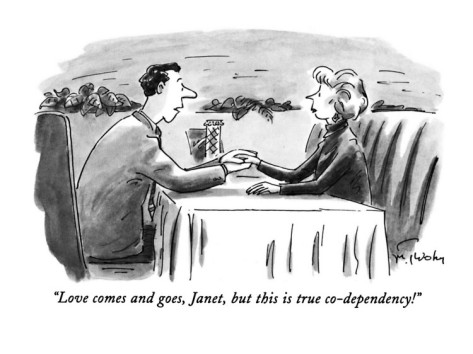
Codependence or co-commitment?

mike-twohy-love-comes-and-goes-janet-but-this-is-true-co-dependency-new-yorker-cartoon

=============================================

Codependence or co-commitment?

From the book LOVE IS THE CHOICE By Robert Elias Najemy


=============================================


For some time now two new words have become very popular in studying the Psychology of Relationships. They are codependence and co-commitment and each describes a totally different types of relationships.

Codependence

Codependence describes a situation in which two people are dependent or addicted to each other. We lose the ability to be happy within ourselves and become dependent on each other for our feelings of meaningfulness, safety and self worth. We are limited by the relationship rather than helped to grow within it.

Codependence breeds antagonism and games in which one tries to control the other, often through various roles, by intimidating, questioning, criticizing, playing the victim or retreating into oneself and becoming aloof.

Such relationships often result in vicious circles in which no one changes and no one is happy. We might even undermine our own happiness and power because we are afraid to be happy or strong when the other is not. Promises or perhaps even threats that serious changes are going to take place seldom become reality.

We feel responsible for the other¢s reality and cannot let him or her feel unhappy. We try to change the other¢s mood, and until the other changes, we cannot feel happy ourselves. Our state of mind is dependent upon the other¢s condition, behavior and attitude.

In codependence, our fears prevent us from telling the whole truth to the other and sometimes even to ourselves.

Criticism becomes a major form of communication and arguments continuously recycle. Most arguments revolve around the ancient game of “who is right.”

When we are dependent on someone, we will often deny our own needs and even our values in order to ensure the other¢s acceptance and / or approval. We might find ourselves not only ignoring our needs, but also doing things we do not really want to do.

C0-commitment

In co-commitment, we feel close to each and want to share our lives without feeling dependent or that we cannot be happy alone or with someone else. We want the other to be happy and we do whatever we can in order to help him or her be happy, but do not believe we are responsible if he or she is not. We can continue being happy even when the other is not.

We see the relationship as a growth process and know that essential to that growth is being able to be truthful with ourselves and each other. We learn to be truthful about needs, thoughts and feelings.

We love each other and want the other to blossom and succeed in whatever he or she chooses to pursue. There is no antagonism, but rather mutual support and encouragement. We feel joy rather than jealousy when the other succeeds.

In co-commitment, we take 100% responsibility for our reality and allow the other to do the same. We do not expect the other to solve our problems or make us happy. That is our responsibility. Also we realize that we cannot make the other happy. We help and support each other, but cannot create the other¢s reality.

Moving from codependency to co-commitment

In co-commitment, we learn to confront our fears of becoming intimate. This is not always easy at first as we may have fears about getting very close to someone. Some of those fears might be:

a. I am not worthy, and if the other knows me well, he or she will not want to be with me.

b. I might be hurt, rejected or betrayed.

c. The other might abandon me and I will not be able to cope.

d. I will lose my freedom.

e. I will not be able to be myself.

A part of the co-commitment relationship is to be able to be intimate while simultaneously independent. Few have managed to find this balance. Some have mastered the ability to be close, but find it difficult to be happy alone. Others may find it easier to be alone, but are not able to be intimate.

Some of the behaviors that possibly exhibit a fear of being very close with someone might be:

a. We withdraw into ourselves and avoid deep or meaningful contact with the other.

b. We mentally manufacture faults in the other so that we are justified in not getting closer.

c. We become emotionally numb and lose contact with our feelings.

d. We start arguments in order to create a distance from the other.

e. We subconsciously create an illness that prevents us from getting closer.

f. We tend to live in the past and avoid the present, and thus contact with the other.

g. We become absorbed in our work, hobby or any activity in order to avoid the other.

The above reactions are unconscious self-protective mechanisms, which unfortunately seldom protect us and always imprison us in lives without love or growth. Such reactions will be even more prevalent when the others are playing roles such as intimidator or interrogator and in some cases even victim and aloof.

But just as we have the fear getting close to the other, we also fear being too far away. There is a Greek saying, “We cannot be happy together and cannot be happy apart.”  When then can we be happy? This is the nature of codependence – fear of being close and fear of being apart.

Another anecdote illustrates the twin fears of being close and being apart. A son asks his father for advice. “Father I do not know what to do, get married or not.” The father shakes his head, “What can I tell you my son, whatever you choose, you will regret it.”

Personal space and time

Our movement toward co-commitment means overcoming the fear of being apart. This does not mean separating, but rather being able to feel comfortable when the other may need his or her “space” or personal time in which he or she can do things without us. One of us might want to walk alone, listen to music, pray or meditate, attend a lecture or seminar or go out with old friends or classmates.

There are times when we might not want to do anything special, but would simply like to be alone. We need this occasionally in order to relax more deeply and renew our energy body. When we are with others, we frequently feel the need to be in a state of alertness. Perhaps we feel the need to communicate with them or serve them in some way. Many of us cannot be ourselves in front of others. Thus, most of us need some time alone when we can simply be ourselves.

Unfortunately, many relationship partners do not feel comfortable taking this time for themselves or giving it to the other. Some reasons for this are:

a. We feel abandoned by the other or fear the other will feel abandoned by us.

b. We are afraid the other cannot take care of himself, or we have not learned to care for ourselves.

c. We think, “If the other really loved me, he or she would always want to be with me. He or she would always prefer me to his or her friends. Couples must be always together.”

d. In some countries, such as the Mediterranean and Arab countries, it is inconceivable to some men that their wives could possibly leave the house and have interests other than the family. Thus, these men feel hurt and even demeaned by the fact that their wives might enjoy a series of lectures or a small excursion only with the ladies. They might fear losing control, something that is important to their sense of security and male self-image. As always, there are exceptions.

e. Some of us are unable to entertain ourselves while alone. We have no interests with which to occupy ourselves. All our energy is locked into others, and when they are not there, we do not know what to do, how to pass the time. We have not learned to be by ourselves or how to occupy ourselves. This is why many people, when they are alone for some period of time, immediately get on the telephone or turn on the TV.

Moving from codependence to co-commitment means facing these fears and being able to be happy and fulfilled even without our loved one, at least for short periods of time.

Sensitive issues

Another problem of codependence is that we tend to function unconsciously or automatically, relative to certain issues, often getting sucked into the roles of the intimidator, interrogator, victim and aloof. Some of those issues that trigger those roles are:

a. Whether we can trust the other or not.  We think, “She might abandon me.” ” He might cheat on me.” “She might hurt me.” “He might try to suppress me.” As a result we get locked into control games, functioning unconsciously without love or real communication.

b. The question of authority, power and control. Who will decide what will happen? Who will get his or her way? Whose will is going to prevail? We unconsciously engage in games for power and control so we can satisfy our needs.

c. Our feelings of self-worth are very fragile and easily shaken by rejection or other¢s behaviors. We then become defensive in our attempt to protect our self-image.

d. We have feelings that have been repressed in us for many years. Some may be from this relationship and others from those much earlier in our lives. These feelings are unpleasant and we often seek to conceal them. All of these unconscious reactions dampen our vitality and obstruct honest communication.

e. Sexual issues are often difficult to deal with because we have an inherent feeling of shame about our sexual needs, and also because much of our self-image as men or women is tied up in being sexually desired by our partner.

These issues are seldom discussed in a mature and honest manner so they can be solved. We often try to get what we want by accusing, threatening, criticizing, avoiding, playing the victim, etc.

We need to be able to discuss these needs and issues openly and maturely so that each can get what he or she needs from this conscious love relationship. We need to communicate about our fears of being hurt, the games we see we are playing for control, our doubts about our self-worth, our deeper suppressed feelings and our sexual needs or lack thereof.

Thus, we have a choice to make. We can allow these and other issues to silently destroy our happiness, our relationship and often our health, or we can begin to face them directly in the following way:

a. Discover what we really feel, need and think.

b. Examine, analyze and seek to understand exactly why we feel, need and think what we have discovered.

c. Take responsibility for our needs, feelings and our life situation. The other is not responsible for what we are feeling or creating in our lives.

d. Share what we have discovered with our loved one without criticism or blame.

d. Work internally on getting free from anything we feel is obstructing our happiness or love.

e. Work with the other on finding solutions that satisfy both of us.

Recreating our childhood

Another aspect of moving from codependence to co-commitment is to free ourselves from our childhood programming. Many of us tend to “recreate or attract” one or both of our parents in our spouse or even in our children. We unconsciously choose persons who are very similar or opposite to our parents. We also tend to embody our parents’ qualities in our selves. In this way, we work through various dramas that were initiated in our childhood years.

If we function unconsciously relative to these issues from our past, they will simply fester and poison our happiness and relationship. So many times, while counseling persons having difficulty with their loved ones, we have come to the very clear conclusion that they are simply recreating what happened with one or both of the parents, and that, if they do not work on transforming what happened in the past, the possibilities for harmony in their present relationship are slim.

Maria and John

Maria and John love and respect each other, but they are plagued with frequent arguments and clashes in which each departs feeling hurt and abused. John feels Maria does not accept him, always tells him what to do, or questions what he has done. He perceives her as his interrogator.

When John feels that Maria doubts his ability or his judgment, he interprets that she is doubting his self-worth, something his mother did continuously by telling him he would never accomplish anything in his life. He then protects himself by shouting angrily so as to intimidate her.

Maria fears his behavior, as this is exactly what her father did when she was a child. She backs off and closes into herself for days, feeling misunderstood, hurt and abused. She now feels that she is the victim.

John also closes up, feeling hurt and unappreciated for all that he does for the family. He cannot accept having his every action and decision doubted. Feeling victimized, he becomes aloof and avoids communication at least for a few days.

Maria then feels left out and rejected because John is not communicating. She feels that he does not love her and begins to seek his attention sometimes in negative ways.

This goes on and on because Maria has not yet worked out her fear of her father and John has not confronted the rejection of his mother. Their freedom lies in working with their inner child.

This process is discussed in the book the Psychology of Happiness and on our web site www.HolisticHarmony.com.

Olga and George

Olga and George also love and respect each other very much. Olga, however, is very much annoyed by George¢s smoking. The smoke bothers her physically, but she is emotionally hurt because he continues even though she has explained how much it bothers her. She is hurt more by George¢s ignoring her request than by the smoke itself. She thinks, “If he loved me, he would comply with my request.”

This is a reenactment of her childhood years when she learned that her needs as a child and as a woman were “not important” and that others would not pay attention to them. She became programmed to believe that, as a woman, she was simply there to serve and sacrifice.

George loves and admires his wife. He, however, feels that as the man of the house, he cannot be running out to the balcony every time he wants to smoke. This is his home which he has created through his hard work. He doesn¢t want to bother his wife with his smoke, but he cannot accept being limited in this way. He feels that his self-image as a man is being intimidated by her request.

This too is reflection of his childhood when his parents limited his freedom of expression.  He now wants to be free to do as he pleases. Olga also wants to be able to express her needs and have them respected.

Each will have to work on transforming those childhood experiences. In addition, they would do well to employ techniques for solving problems where their needs conflict. The chapter on conflict resolution guides on how to resolve conflict in needs between couples.

The following checklist helps to summarize the difference between codependence and co-commitment.

SYMPTOMS OF CODEPENDENCY

1. We need the others approval. We fear his or her rejection.

2. We cannot feel well if the other does not feel well.

3. We need to solve the other¢s problems for him.

4. We cannot be happy unless the other is satisfied with us.

5. We need to protect the other or be protected by him or her.

6. We need the other in order to feel secure, worthy or happy.

7. We are afraid to tell the truth because the other might become hurt or angry.

8. We lose contact with our needs and live through the other¢s needs.

9. We cannot imagine living without the other.

10. We compete for power and self-worth.

11. We avoid participating in the other¢s interests.

SYMPTOMS OF CO-COMMITMENT

1. We accept ourselves and the other.

2. We want the other to be well, but can be well when he cannot or chooses not to be.

3. We help the other in any way we can, but do not take responsibility for solving his or her problems.

4. We want the other to be satisfied, but can be happy even when he or she is not.

5. We have faith in our mutual ability to protect ourselves.

6. We feel safe, secure and happy from within.

7. We communicate truthfully in all cases.

8. We try to find a fair balance between our needs and the other¢s.

9. We want to be together and enjoy each other, but can accept sometimes being apart.

10. We empower each other.

11. We participate in each other¢s interests.


How to use Inspired Questions in combination with brain balancing.

How to use Inspired Questions in combination with brain balancing.

How to use Inspired Questions in combination with brain balancing.

 exisoropisi

  1. Chose the inspired question which you would like to use in order to install a  certain belief.

Examples might be

WHY DO I FEEL SO SAFE WITH ALL PEOPLE?

WHY AM I FEELING SO SAFE IN GENERAL?

WHY AM I WORTHY OF LOVE AND RESPECT EXACTLY AS I AM?

WHY AM I FEELING FREE TO BE MY SELF?

WHY AM I FEELING UNDERSTANDING TOWARDS THAT PERSONS BEHAVIOR?

WHY AM I SO FORGIVING?

WHY AM I SO COMFORTABLE WITH MYSELF AND OTHERS.

WHY AM I AM ABLE TO LOVE MYSELF AS I AM?

WHY AM I FREE FROM NEEDING APPROVAL?

WHY DO I PERCEIVE LIFE AS SO EASY?

WHY DO I ACCEPT MY WEAKNESS AND MISTAKES?

WHY AM I SO SURE OF MY ABILITY TO SUCCEED.


  1. Then take the position for the brain balancing with the right ankle resting on the left and the right wrist over the left while meshing the fingers.


  1. Begin to mentally repeat the chosen question over and over in a relaxed way, not to prove it to yourself, but simply because it is a truth or possible truth. Do this for about two minutes asking the inspired question over and over.


  1. Then stop asking and for about two minutes receive possible answers to that question – practical, logical and spiritual.


  1. The for another two minutes repeat the question again and again stopping each time to receive answers that come to you after each repetition of the question . The answers can also be the same and also new ones each time. So you ask the question and receive as many answers that come and then ask again and receive answers.


  1. Now switch the ankles and hands, placing the left on top.


  1. Now bring to mind a scene from your daily life where perhaps your ability to experience the particular truth is challenged or more difficult. Imagine and experience that you are able to experience that truth (and any other useful truth) while confronting that particular stimulus or situation which until now has caused you to lose your peace. Do this then with two more scenes, imaging and experiencing in each that you are able to feel centered, worthy and safe in each situation.


  1. Then place the finger tips of your opposite hands together and feel that this new positive perception, belief and feeling are being deeply installed in your conscious and subconscious mind.


Some possible answers to some of the questions might be.

Because there is no reason for any one to want to harm me.

Because I am strong and capable of caring for myself.

Because all of the moments I felt danger have passed and I am still okay.

Because I am a good and lovable person.

Because people in general like me.

Because I am charismatic.

Because I live in a safe country in a safe environment.

Because I have been able to deal with every situation life has ever brought me.

Because my self-worth is a granted and no one can ever change that.

Because my self-worth is a granted and no one increase it or decrease it.

Because I am worthy of love and accept as I am.

Because life brings me only what is in my highest interest as a soul in evolution.

Because we are all expressions of the Divine.

Because I am an immortal expression of the Divine

LISTEN TO THE GUIDED TECHNIQUE HERE

HEALING THE INNER CHILD

HEALING THE INNER CHILD


HEALING THE INNER CHILD

 CHAPTER 23 from the book The Psychology of Happiness by Robert Elias Najemy

Note:

The work described in this chapter usually requires

guidance by a person experienced in this work.


 Our inner child is that part of our subconscious that still feels, thinks and behaves in the ways we learned as children. Our emotional life is largely dictated by the feelings, beliefs and needs generated by our childhood experiences.

We have become split personalities who function with two minds. One is logical while the other still perceives life through the eyes of the children that once we were. While one knows logically that we have no reason to fear or doubt ourselves, the other continues to experience anxiety, fear, guilt and self-doubt. While we know cognitively that we have the ability to deal with life, a part of ourselves continues to be fearful, jealous and angry.

We may not be consciously aware that our inner child feels vulnerable, lonely, fearful, angry or hurt, yet, these emotions are very visible in the form of our fears and defensive reactions. Our hidden emotions are also quite evident in our tensions and psychosomatic illnesses.

On the other hand, our inner child and other aspects of our subconscious are a rich and abundant source of inspiration, joy, creativity and love for life.

We need to establish contact with our inner child and learn to accept and love it as it is, while at the same time educating it concerning the truth of its divine nature. We can then heal our inner child of its traumas and misconceptions while simultaneously recovering from it our innocence, joy and inner connection with life.

Regardless of which techniques we employ in relationship to the inner child, it is essential that we develop a relationship with it by communicating daily. We suggest the following technique.


DAILY COMMUNICATION

WITH THE CHILD WITHIN


1. Sit or lie down with the spine straight.

2. Relax the entire body and mind through your preferred relaxation or concentration technique.

3. Imagine the inner child and communicate with it. (It might appear at any age.)

a. Ask it how it feels.

b. Ask if it has some needs it would like to satisfy.

c. Speak to it about your needs as an adult.

4. Give it positive reinforcement. Our child needs to hear about love, security and self-worth.

5. Mentally embrace the child and hold it with tenderness and love.

a. Feel (imagine) the child in your arms.

b. Identify with the small body and feel yourself inside the embrace accepting the love and tenderness offered to you.

c. Become one with the child.


This technique can be performed as a prelude to any meditation, relaxation technique, prayer or positive projection technique, or alone as it is. Once mastered, it takes only five minutes.


DISCOVERING OUR PAST


Our first step will be to discover the events that might have programmed our inner child to be overly sensitive to situations or stimuli, which we now objectively realize, are not worth losing our peace over. In studying the following list of possible childhood experiences, we might find some experiences described exactly as we remember them, while others may remind us of experiences that are somehow different than the ones described. Some memories or associations may take time to come. We may be reminded of something else of which we would like to take note.


LIST OF CHILDHOOD EXPERIENCES


Note: After each experience, you will find a list of numbers with the letter “B” referring to the list of possible beliefs, subconscious conclusions of the child, which may have been programmed into our childhood mind because of these experiences.  This list can be found on our web site www.HolisticHarmony.com. The numbers here refer to the numbers of the beliefs on that list.

Wherever the questions refer to our parents or other persons of our childhood, we must also think of stepmothers, stepfathers, grandparents, uncles, aunts, brothers and sisters, cousins, teachers and any other persons who existed in our lives as a child up to the age of 18.


1. Was there someone who became angry with you, scolded you, rejected you or accused you? Who and when?  B=(1,2,3,4,5,6,7,13,14,15,16,70,142,143).


2. Were there people in your family who fought among themselves or rejected or hurt one another? Who and when? B=(1,2,3,4,5,6,143).


3. Have you ever experienced the feeling of abandonment? Were you ever left alone? Have you ever felt that others didn’t understand you, or that you would receive no support? When? By whom? How? B= (1,4,8,9,10,11,12,13,14,15,16,70,142).


4. Did you ever feel the need for more affection, tenderness or expression of love? From whom and when (during which periods of your life)? B= (1,13,14, 15,16,142).


5. Were there persons in your environment who were often ill or who often spoke of illness? Did they ever blame you for their illness or did you ever feel guilty concerning their illness? Who and when? B= (17,18,19,20,21,22).


6. Did you ever experience the feeling of humiliation in the presence of others or in connection with others? In which cases? B= (1,4,5,8,14,23,24,25,70,143).


7. Were you ever compared to others as to whether you were less or more capable or worthy? To whom, in which instances, and in connection with which abilities or character traits? B= (1,23,24,25,26,70,143).


8. Have you ever lost a loved one? Who and when? B= (7,8,9,10,11,12,14,15,17, 18,21,27,28,2,142).


9. Did anyone ever approach you sexually without your consent? Who, when, and how did you feel? B=(1,30,31,32,33, 34,136,142).


10. Were you ever aware of your parents or anyone else making love? Who and when? How did you feel and what did you think? B= (33,34,35,36,37).


11. Did your parents ever state that you were the only reason they stayed together, and that this had been a big sacrifice on their part? Did they ever tell you they had sacrificed a great deal for your sake, and that you were indebted to them? Who? When? About what matters? What exactly do they believe you owe them?  B= (1,6,38,39,40,41,41,42,43,141,143).


12. Did anyone ever accuse you of being the cause of his or her unhappiness, illness or problems? Who accused you and about what exactly? What did they mean by saying that it was your fault? What does this statement mean to you? According to them, what should you have done? B= (38,39,40,41,42,43,44,45,46,47, 48,49,50,51,52.53,54,141,143).


13. Did anyone ever say you would never achieve anything in your life, that you are lazy, incompetent, or dumb? Who, when and concerning what matters? B= (55,56,57,58,59,60,141,142,143).


14. Were you ever caught playing with your genitals (alone or with others), and did anyone make you feel guilty about that? Who? When? What was their message? B= (61,62,63).


15. Did anyone speak about guilt and punishment from a person, a parent, the police or God? Who? When? About what types of guilt and what type of punishment? B= (1,62,63,64,65,141,142,143).


16. Did any teacher ever make you feel humiliated in front of other children? When? How? Concerning what? B= (66,67,68,69,142,143).


17. Did you ever feel rejection or inferiority in the company of other children? By whom? Inferior by what criteria? B= (23,24,25,26,70,142,143).


18. Were you ever told you were responsible for the general well being of your siblings or others, and that whatever happened to them was your responsibility? Who did? About whom? Concerning what matters were you responsible? B= (44,45,46,47,48,49,50,51,52,53, 54,141,143).


19. Were you ever made to understand in some way (negative or positive) that in order for someone to be acceptable and lovable, one must: B= (141,142,143).

___a. Be better than the others?

___b. Be first at everything?

___c. Be perfect, without faults?

___d. Be intelligent and clever?

___e.  Be handsome / beautiful?

___f.  Have perfect order and cleanliness at home?

___g.  Have great success in his/her love life?

___h.  Be financially and socially successful?

___i.  Be accepted by everyone?

___j.  Be active in many ways? Achieve many things?

___k.  Always satisfy the needs of others?

___l.   Never say “no” to others?

___m. Never express his/her personal needs?


20. Did anyone ever make you believe in some way that you were incapable of thinking, making decisions, or achieving things by yourself, and that you would always need to depend on others? Who passed on this message to you? About what matters were you supposedly “incapable” of making decisions or handling life properly? B= (91,92,93,94,142,143).


21. Did you ever have role models (parents, older siblings or others) who were, or still are, so dynamic and competent that you felt: B= (95,96,97,98,141,142,143).

a.  The need to be like them?

b. The need to prove your worth, to reach or even surpass these models?

c. Despair, self-rejection, abandonment of effort, self-destructive tendencies (possibly subconscious), because you believed you could never measure up to them?

In connection with whom has any of this occurred (a, b or c) and with what criteria of success?


22. Has there ever been in your environment someone with unexpected, unpredictable, nervous or even schizophrenic behavior (possibly alcohol or drug induced) making it difficult for you to anticipate what he or she might do next? Have they engaged in violent behavior (physical or psychological)? By whom, and what was the behavior like? B=  (1,2,3,4,5,6,7,8,11,12,13,14,15,16,99,100, 101,102,103,104,105,106,107,108,135,142)


23. Have you felt rejection towards or shame concerning one of your parents? For whom and why? B= (109,110,111,112,142,143).


24. Did you ever make the discovery that one of your parents had an extra-marital affair? When and under what circumstances? How did you feel about that?

B= (83,104,109,110,111,112).


25. Did anyone often speak to you about a vengeful, punishing God or about the “Devil?” Who did, and in what context? B= (1,62,63,64,65,113,114,135,141,142,143).


26. Did you ever feel that someone told you one thing but did another, that there was no consistency in their words, that they had a double standard – one for themselves and another for others – or that they were hypocritical, false and deceptive? Who and when? Concerning what topics? B= (115,116, 117,118,119,120,121).


27. Upon what was your parents’ security based?

___a) on money?

___b) on the others’ opinions?

___c) on education?

___d) on personal power?

___e) on the unity of the family?

___f) on property?

___g) on one’s spouse?

___h) other? _________________________

B= (122,123,124,125,126,127,128,129,142,143).


28. Were you a spoiled child who always got whatever you wanted, and to whom no one ever refused a favor? B= (131,132,142).


29. Did anyone suppress your freedom of movement and expression? Did they force you to do things you did not want to do? (study, visits, dress). Did they forbid you to do things you wanted to do? What were you forced to do or prevented from doing? B= (135,136,137,138,142,143).


30. (FOR WOMEN). Did anyone in some way try to make you believe that since you are a girl:

a. You are worth less than a man?

b. You are not safe without a man?

c.  Sex is dirty (a sin)?

d. You must be married in order to be socially accepted?

e. You are less competent than men?

f.  Your only mission is to serve others?

g. You must not express your needs, feelings or opinions?

h. You must submit yourself to your husband?

i.  You must be attractive to be acceptable?

B= (133 a,b,c,d,e,f,g,h,i,j,k,l,m,n,o, 141,142.143).


31. (FOR MEN). Did anyone in some way try to make you believe that since you are a boy:

a. You must be strong?

b. You must be superior, more competent, stronger and more intelligent than your wife?

c. Your self worth is measured according to the success of your love life or the number of your sexual conquests?

d. Your worth is measured according to your professional (financial) success?

e. You must compare yourself with other men?

B= (134 a,b,c,d,e,f,g,h,i,j,k,l, 141,142,143).


ADDITIONAL AIDS FOR THE

SEARCH INTO THE CHILDHOOD YEARS


In addition to this list of childhood experiences, we can also search the past in the following ways:


1. Through childhood regressions: Guided by a well-trained professional, we can re-experience memories of the past.


2.  By writing the story of our childhood years, we can strengthen our contact with the details of the past. This can be written in the first person, but even better in the third person, as if we are chronicling the life of some other person. This enables us to be more objective and honest in our observations. We will discover patterns of behavior that we tend to repeat throughout the years. We will find the experiences that have marked our subconscious, creating our emotional mechanisms.

This life story need not be detailed in chronological order. Each day, we can add whatever we remember in any order.

The first comment made by many people is, “ I don’t remember anything before the age of ten. How will I do this?”  This is no problem. As we start to write, the subconscious will be awakened and memories will start flowing forth. The more we write, the more the memories will be activated.

Placing old photographs before us as we write will help, as will asking parents, grandparents, uncles, aunts and older brothers and sisters what they can remember. We are not obligated to accept their interpretation of the past, but their words may trigger other memories.

Best results will be obtained if we dedicate at least twenty minutes daily to this process for at least three months.


The basic guidelines for writing the story of our childhood years are:

a. Add whatever additional memories you remember each day.

b. It need not to be in chronological order.

c. We can write in the third or first person.

d. Ask others (parents, uncles, aunts, siblings, grandparents) what they remember.

e. Look at old pictures.


3. A questionnaire for getting acquainted with the inner child

Answering these questions will assist our investigation into the messages we might have received in our childhood years. Complete the following sentences with at least three answers for each if possible. Also, try to remember exactly what happened which caused you to come to those assumptions.

a. As a child, I heard that my most significant faults were…..

b. As a child, I felt guilty about/for….

c. Some messages I received about God were…

d. Some messages I received about sex were…

e. Some messages I received about money were…

f. I felt rejection when…

g. I felt fear when…

h. I felt shame or inferiority when…

  i. I felt abandonment when


4. A deeper questionnaire concerning our beliefs

The following questionnaire will give us supplementary information concerning the programmings we developed in those early years. Please answer as honestly as you can, allowing enough time to establish contact with the various parts of your personality.  Do not be surprised by needs, desires, beliefs and feelings that seem to conflict or be contradictory. This is quite common and natural for a person in the process of evolution who is passing through changes in his values, beliefs and needs.


Give three or more answers to each question.


A. The basis for our feelings of security.


1. The three positive human characteristics which I value most are …

2. The three negative human characteristics that I find most unacceptable are…

3. I love and accept myself more when ….

4. I feel guilty when …

5. I have negative feelings when…

6. I feel happy when …

7. I feel insecure when…

8. I feel secure when…

9. I do not believe I can ….

10. If my house were on fire and I could save only three objects (excluding people or animals), they would be…..

11. My three strongest fears are….


B. How I perceive others and how I believe they perceive me.

12. How I believe my spouse or love partner perceives me. (Or previous spouse or love partner. Or all spouses and love partners we have had until now.)

13. Three of my spouse’s (love partner’s) positive traits are …

14. Three of my spouse’s (love partner’s) negative traits are…

15. How I believe my parents perceive me….

16. My parents always told me that I was unable to …

17. The criticism I heard most often from my parents was…

18. Three of my father’s positive qualities were/are…

19. Three of my father’s negative qualities were/are…

20. Three of my mother’s positive qualities were/are…

21. Three of my mother’s negative qualities were/are…

22. This is how I remember my parents’ relationship until I was 21 years old.

23. I find it difficult to forgive others for…


C. How I see myself.

24. I feel weak and vulnerable when …

25. The criticism I hear most often from those around me is…

26. Three of my positive character traits are…

27. Three of my weaknesses or faults are …

28. I find it difficult to forgive myself for…

29. I feel unable to …

30. I wish I could …

31. I imagine God to be…

33. I feel God in my life when …. and in this way …

34. My life purpose is ….


35. Now imagine that you are writing to a very good friend whom you have not seen since grammar school, and you want to describe yourself to him. How would you do it?


Having discovered various experiences, which in the past were painful for us or have programmed us in negative ways, we can go on to analyze each experience separately with the help of the following questionnaire.


ANALYSIS OF UNPLEASANT CHILDHOOD EXPERIENCES


a. Describe an experience or general situation which was unpleasant, that made you feel fear, sorrow, guilt, rejection, danger, injustice, jealousy or any other unpleasant emotion.

b. What were the exact emotions you felt as a child?

c. What thoughts did you have, or what conclusions did you reach as a child because of this experience or situation?

d. In what way did you react then as a child?

e. What effect did this experience have upon you later in life, or even today?

f. If you could have been absolutely open and honest at that time, what would you have said to your parents, teachers, God or to others who played a part (or who were with you) in this event or in this situation concerning:

1. What you felt?

2. Your needs and desires?

3. What you wanted them to do or not do?

(Write the answers in the second person, as if you were speaking directly to them or writing them a letter).


When you finish with one experience or situation, go on to another and another, answering the same questions.


EXPRESSING THE EMOTIONS OF OUR CHILDHOOD YEARS


Once we have established contact with some of the unexpressed emotions, needs and beliefs of our childhood years, the next stage is to express and release them without, of course, hurting others. Some ways in which we can do this are listed here.


1. Write letters to the people who played an important role in the unpleasant and pleasant experiences of your childhood (parents, teachers, uncles, aunts, siblings, grandparents, others). We will not necessarily send these letters. We simply need to write them, in order to recognize and express what is hidden within us.

a. Communicate totally, openly and honestly.

b. Add new thoughts and feelings each day.

c.  Do not concern yourself with chronological order.

d. Express how you felt at that young age (not how you see it or explain it now).

e. Release and express your negative and positive feelings.

f.  Express the needs, feelings, desires and thoughts you had at that time.

We will also want to express our positive feelings, love and gratitude.


2. Read these letters to someone who is experienced in active listening and psychodrama.

a. If you find that reading these letters causes strong feelings, take time to express and release those feelings before you continue reading. You may then need to switch to an emotional release technique. Do not keep these emotions locked inside you.

b. You may need to read these letters additional times until the emotional charge is released. You can read it as many times as necessary until you are able to read it without feeling upset about the letter’s content.


3. Below is a more detailed questionnaire that will help with the clarification and expression of exactly what we felt, needed and believed as children. It is best if we write with the opposite hand than the one with which we usually write.  In this way, we can more easily connect with the weakness, difficulty and vulnerability we experienced in those childhood years. It also stimulates the opposite side of the brain, bringing more memories to the surface.


Questions which aid in expressing our feelings as children


We imagine that one of the persons who played an important role in our childhood experiences is asking us these questions. We answer the questions separately for each person with whom we want to communicate.

It does not matter if the soul we are writing to has left his or her physical body. It does not matter whether the other can fully understand what we are writing. We are not writing this to give it to anyone (although, if we feel that it will help the other, we are free to do so). We are writing this in order to discover, understand and express ourselves more deeply.

We have everything to gain by being as honest as possible by answering from our inner child. If there are matters about which our inner child feels differently from our adult, we can express both sides if we choose, but it is best to place emphasis on the inner child’s opportunity to express it self.

These are the questions we are being asked by this person:


a. Tell me, when you were a child, did I do anything which upset you, hurt you or made you feel fear, rejection, guilt, injustice, bitterness, disappointment, guilt, anger or some other negative emotion?

b. Please tell about each occasion, situation or behavior separately. Give me the complete details:

1. What exactly did I do or not do?

2. How did you feel?

3. What did you think then?

4. What conclusions did you draw about yourself?

5. What conclusions did you draw about me?

c. Did you feel that I had high expectations of you, that I wanted you to be something special? Please explain to me exactly what you believed I wanted you to be physically, mentally, emotionally, socially, spiritually, etc. Perhaps because I praised you for some things, you believed that I accepted and loved you only if you excelled in those areas?

1. How did you feel about that?

2. What did you think then?

3. What conclusions did you draw about your self worth and love in general?

d. What other emotions would you like to express to me?

e. What did you need from me then which I did not give you enough of?

f.  What would you have liked me to do then which I did not do?

g. What would you have preferred that I not do which I did?

h. Did you ever feel guilt, shame or self-rejection as a child?

1. At what times and for what reasons? What did you do, say or think?

2. What did you believe which made you feel guilty?

3. Did I, in any way, cause you to feel guilty in those situations? How?

4. Were others also instrumental in causing you to feel guilty? Who, and for what?

5. What would you like to say to me or to the others concerning those situations?

i. What could I do now, to help you feel better?

j. What could you yourself do now in order to feel better?


The above questions help us clarify what we need to express and release. The rest of the questions have to do with the process of transformation, and are best left until we feel we are ready to accept what happened, to forgive the perpetrators, and move on with a clean state. We will present them here but they should be used only when we are ready

Questions which aid in transforming:


k. What thought-forms (conclusions, beliefs) were created in you then due to those experiences?

l. Which of those thought-forms (conclusions, beliefs) have you totally overcome, and which are still alive in you, even to a small degree?

m. What do you think was my inner state, which caused me to behave the way I did then? (Remember that we are imagining that the person who may have hurt us with his behavior is asking us these questions.)

n. What do you think were the motives, needs, feelings, and beliefs that caused me to behave the way I did then?

o. If the spiritual truth that “life gives us exactly what we need as souls in evolution in order to evolve and develop spiritual virtues,” is actually true, what could be the lessons or the virtues which you are being asked to work on here?

p. What do you need to learn here in order to be happy?

q. Which beliefs do you need to change here in order to free yourself from the false beliefs of the past?

r. What do you need to do or believe in order to forgive me and free yourself from my presence in your subconscious?

s. What do you need to do or believe in order to forgive yourself and enjoy your purity and goodness?

t. What changes do you want to make in your lifestyle in order to find harmony and strength? How and when will you make these changes?


POSITIVE MESSAGES FOR OUR INNER CHILD


The following is a list of possible messages for our inner child, which can be strengthened internally by:

a. Writing them in a letter to the inner child

b. Introducing them to the inner child while in the transformation regression.

c. Replaying them our daily communication with the inner child.

d. Making a relaxation cassette with these messages.


1. I accept and love you exactly as you are.

2. I appreciate you and respect you.

3. I feel affection and tenderness for you.

4. You are free to do what you like provided you are not hurting anybody.

5. You are capable and strong.

6. There is an infinite spiritual power within you that protects you from illness, traumas and dangers.

7. Your body is healthy, strong and resistant to illness.

8. You live in divine justice which brings to you only what is useful for your development.

9. You selected your parents and the events of your childhood, and thus you created the perfect conditions for your development.

10. There is a Divine Power that guides you from within.

11. There is within you a knowing and wise voice that always leads you correctly in your life. Follow it.

12. You have the right and the responsibility to express your inner strength and beauty creatively.

13. You deserve love and respect from everyone, regardless of your appearance, social position, profession, knowledge, achievements, or what others think of you.

14. Your self worth is the same as that of every other soul, no more and no less.

15. No one else can create or be responsible for your happiness, health or success.

16. You cannot create or assume responsibility for the happiness, health or success of others.

17. You are an eternal, divine consciousness in the process of developing the ability to express the beauty that exists within you.

18. Everything is God. There is no one or thing that is not the expression of the one universal consciousness (God). You are no exception.

19. It is not necessary to live your life according to the convictions or expectations of your parents or anyone else. Love, respect and help them, but live according to your own principles, needs and convictions.

20. Your “parents” are eternal souls in a process of evolution whom you selected to play these roles in this incarnation. Your only real parent is God.

21. You have the same worth, wisdom, strength, and rights as the eternal souls who played the role of your parents.

22. Whatever anyone did to harm you was out of ignorance or fear.

23. Your parents were once children who were programmed by their parents.


Having healed the inner child through these truths, we are now ready to begin the process of forgiveness, which is our liberation from the past. If upon working with your childhood years you realize that you need to forgive others or yourself, refer to the chapter on forgiveness in the book Relationships of Conscious Love by the same author. (This chapter can also be found on our web site)

The Mental and Spiritual Benefits of Loving

The Mental and Spiritual Benefits of Loving


The Mental and Spiritual Benefits of Loving


From the book LOVE IS THE CHOICE By Robert Elias Najemy

=============================================


Why Chose love? How does it benefit our life? What is in it for us? These questions may appear to be in direct contradiction with the ultimate meaning of love, which is to transcend our imprisoning exclusive identification with our personal self. But this is why it is useful to help this self-centered self to realize how much more it has to gain by choosing love over fear, mistrust, alienation self-protection, bitterness, resentment, pain and anger.


We have already mentioned the obvious – now scientifically proved – benefits to our health and healing. Here we will focus on the emotional, mental and spiritual benefits.


Choosing love means overcoming fear, which is our greatest obstacle to health, happiness and success. As we remove our inner obstacles to love, we necessarily transcend our fears and doubts concerning self-worth, security and freedom.


Choosing love brings us in direct contact and confrontation with old beliefs and programmings, presenting us the choice to move forward to freedom from these or stay in our stagnant illusion of security.


Choosing love allows us to mature emotionally, mentally and spiritually, enabling us to higher levels of consciousness, spiritual perception and energy. We are then free to access greater creativity, joy and success in our lives.


Choosing love when someone harms us, means learning our life lessons and freeing ourselves from the cycle of karmic pain. By choosing to forgive and love, we break -for ourselves, at least – that cycle of harm, anger, hate and pain.


Choosing love gives us the energy to free ourselves from attachments and habits that obstruct our energy and love.


Choosing love encourages us to remember and employ spiritual truths in our daily life, thus enhancing our spiritual growth.


Choosing love inspires others to do the same. We and all of society then experience that increased expression on love. We all become more loved.


Choosing love brings us peace, because we experience harmony with our conscience and highest ideals. We feel good about ourselves and our lives.


Choosing love makes us wiser and stronger on all levels. True love can flow only from wisdom and strength.


Choosing love removes the veil of ignorance limiting our programmed mind.


Choosing love allows us to do unto others as we would like them to do to us. It allows us to be our highest self. To be the person we really want to be.


Choosing love brings us in alignment with my our purpose and that gives us peace, meaning and fulfillment.


By loving others, we create an atmosphere of love, understanding and trust. We then attract and enjoy that same love, understanding and trust from others. Others seek and enjoy our presence. We become a source of love, compassion, service, comfort and encouragement. We experience unity and friendship. We enjoy the beauty of loving and being loved.


We can choose love over fear, ignorance, bitterness, pain, anger, hate, revenge and alienation. It is worth facing every illusionary danger and doubt concerning our self-worth, security, freedom and control. We can choose love even over the fear and pain of rejection and death. There is nothing higher, nothing more beautiful, than love – it is worth all sacrifices and illusions. It is what allows us to experience our higher self. No amount of knowledge, wisdom or discipline opens the door to higher levels of consciousness, peace and happiness and easily as love.

Yoga Glossary – Sanskrit to English

Yoga Glossary – Sanskrit to English

Yoga Glossary

Abhyasa                 practice – the act of practicing

Acharya                 teacher

Adwaita                 a philosophy according to which there is no duality – only a singular state of consciousness

Agni        fire

Agnisar kriya     one of the shatkarmas (cleansing practices) -intestinal cleansing

Aham     ego

Ahimsa                   non-violence, non-injury – one of the yamas of ashtanga yoga

Ajapa japa             spontaneous repetition of ‘soham’ mantra

Ajna chakra         energy center located behind the forehead, also called psychic centre – one of the seven energy centers

Akasha ether, space

Anahata chakra                  energy center located in the heart region; also called pranic centre – fourth of the seven energy centers.

Ananda                   bliss, ecstasy

Antar     inner, internal

Antar dhauti       internal yoga cleansing (shatkarma) techniques

Antar kumbhaka               internal breath retention. The stage of pranayama where breath is retained after inhalation.

Antar mouna      internal silence – a meditation practice.

Anubhava             experience, realization

Ardha    half

Ardha dhanurasana         half bow yoga pose

Ardha matsyendrasana                   half spinal twist yoga position

Ardha padmasana             half lotus pose

Asana    yoga position or yoga pose, also called yogasana. A balanced position for smooth energy flow in specific areas of the body and mind.

Ashrama               residential place of people living together in yogic tradition.

Ashtanga yoga   the eight fold path of yoga as outlined by Patanjali: yama, niyama, asana, pranayama, pratyahara, dharana, dhyana, samadhi

Ashwini mudra                   practice of contracting the anal sphincter.

Atman   soul.

Aum       see Om

Avidya   ignorance

Bahir     outside, external

Bahir kumbhaka                external breath retention. The stage of pranayama where breath is retained after exhalation.

Bahiranga trataka             concentrating the attention (gaze) upon an external object such as a candle flame.

Bandha                   a posture in which organs and muscles are contracted to create energy lock in a specific area.

Basti      a colon cleansing technique (shakarma), yogic enema

Bhagvad Gita      a part of the famous Hindu epic ‘Mahabharata’. Teachings of Lord Krishna to his disciple Arjuna at the commencement of the battle of Kurukshetra, with explanations on sannyasa yoga, karma yoga, bhakti yoga, and jnana yoga.

Bhakti   devotion

Bhakti yoga         the yoga of devotion.

Bhastrika pranayama     ‘bellows’ breathing technique in which the breath is forcibly drawn in and out through the nose in equal proportions, like the pumping action of the bellows.

Bhramari pranayama     breathing practice in which a soft “humming-bee” sound is produced during exhalation to stimulate the Ajna Chakra

Bhujangasana    cobra’ pose.

Brahman               supreme consciousness, absolute reality.


Chakra  literally meaning circle or wheel, in yoga this refers to the energy centers lying along the confluence of the nadis (energy channels)

Chandra                 moon

Chandra nadi      ida nadi

Chidakasha          psychic space in front of the closed eyes, just behind the forehead.

Chin mudra         hand gesture in which the first finger is kept at the root of the thumb, the last three fingers are unfolded.

Danda   stick

Danda dhauti     one of the cleansing techniques (shatkarmas), used to clean the oesophagus with a stick.

Danta dhauti      teeth cleansing technique

Dhanurasana     bow’ pose; backward bending yoga pose

Dharana                practice of concentration; sixth of the eight fold path in ashtanga yoga

Dharma                 duty, righteous path

Dhauti  second of the shatkarmas; cleansing technique of the eyes, ears, tongue, forehead, oesophagus, stomach, rectum and anus

Dhyana                   meditation; single-pointed focus of mind on either a form, thought or sound.

Diksha  initiation given by the guru.

Dosha   three humours of the body; see kapha, pitta, vata

Dugdha neti        nasal irrigation or cleansing technique using milk

Ghrita neti           neti (nasal cleansing technique) performed with ghee

Gomukhasana   cow’s face’ posture

Gorakshasana   Yogi Gorakhnath’s’ pose

Guna      quality of nature viz. tamas, rajas, sattwa

Guptasana            the ‘secret’ pose

Guru      spiritually enlightened soul, who can dispel darkness, ignorance and illusion from the mind and enlighten the consciousness of a devotee/disciple

Hatha yoga           science of yoga which purifies the whole physical body by means of shatkarma, asana, pranayama, mudra, bandha and concentration

Hridaya akasha                   psychic space of the heart centre

Ida nadi                  one of the main energy channels running on the left side of the spine from the mooladhara (base) chakra to the ajna chakra in the head.

Jala         water

Jala basti               the yoga technique of enema using water – one of the yoga shatkarma

Jala neti                 a shatkarma technique – cleansing of the nasal passages with water by alternating the flow of water in the nostrils, preferably using a neti pot.

Jalandhara bandha           throat lock’ to restrict the flow of bereath through the throat – done by resting the chin on the upper sternum (chest).

Japa        continuous chanting i.e repetition of a mantra

Jihva dhauti        one of the shatkarma techniques for cleansing the tongue.

Jnana     knowledge, understanding, wisdom

Jnana mudra      the gesture of knowledge – in this the index finger is bent so that its tip is joined with the tip of the thumb, the other three fingers are spread out.

Jnana yoga           the yoga of knowledge – attained through spontaneous self-analysis and investigation of abstract and speculative ideas.

Kapal     skull or cerebrum

Kapalbhati pranayama   a breathing technique aimed at cleaning the frontal part of the brain; also called skull polishing – done through rapid breaths with more force on exhalation.

Karma   action; the act of doing

Karma yoga         the yoga of action – aims at supreme consciousness through action; discussed in Bhagavad Gita

Karna dhauti      one of the shatkarma which involves cleansing the ears.

Kati chakrasana                 waist rotating’ pose.

Kevala kumbhaka              spontaneous cessation of breath without any conscious effort.

Klesha   afflictions or tensions – according to yoga there are 5 such afflictions present in humans from birth

Koormasana       tortoise’ pose – an advanced posture.

Kosha    sheath or body; realm of experience and existence.

Kriya      activity, dynamic yogic practice

Kriya yoga             the practice of kundalini yoga

Kukkutasana      cockerel’ pose

Kumbhaka           breath retention

Kundalini              man’s retained energy or potential energy and consciousness

Kundalini shakti                refers to the human’s potential energy lying dormant in mooladhara (base) chakra like a coiled serpent. When awakened it rises up through the sushumna nadi.

Kundalini yoga  philosophy expounding the awakening of potential energy and inherent consciousness within the human body and mind.

Kunjal kriya        a shatkarma (cleansing) technique that involves the cleansing of the stomach by drinking in water and then expelling it by inducing vomiting.

Laghoo shankhaprakshalana      a shatkarma technique – also referred as the short intestinal wash. Involves the drinking of several glasses of water and the expelling it through stool after a series of exercises (asanas); in the process a thorough cleansing of the colon takes place.

Laya yoga              union with the supreme consciousness through pranayama or devotion. Literally, union by absorption

Maha      great

Maha bandha      the great lock – combines the three locks in yoga – the moola bandha, jalandhara bandha and uddiyana bandha – together with breath retention.

Maha mudra       the great gesture – combines the practice of moola bandha, shambhavi and khechari mudras simultaneously.

Maha nadi             literally means ‘great nadi’, which is the ‘sushumna’ in yoga

Makara                   crocodile

Makarasana        crocodile’ pose

Manas chakra    the energy center above the ajna chakra – is depicted with six petals

Manipura chakra               the energy centre in the spinal column located behind the navel – corresponding to the solar plexus.

Mantra subtle sound vibration, which through repetition aims at expanding one’s awareness or consciousness.

Mantra shakti    the power of mantra

Matsyendrasana                a spine twisting pose

Mayur   peacock

Mayurasana        peacock’ pose – advanced pose aims at strengthening the arms and stimulating the manipura chakra.

Moksha                  liberation from the cycle of birth and death.

Moola    root

Moola bandha    energy lock created by the contraction of the perineum in the male and the cervix in the female.

Mooladhara chakra         lowest energy centre in the human body where the kundalini shakti (serpent power) resides – situated in the perineal floor in men and the cervix in women.

Moorchha pranayama    fainting or swooning breath’ in which the breath is inhaled slowly and retained for an extended period.

Mouna  silence – the practice of silence

Mudra   literally means ‘gesture’ – mudra expresses and channelizes cosmic energy within the mind and body.

Nadi       energy channels in the body, similar to the meridians in acupuncture

Nadi shodhana pranayama           breathing technique – is the ‘alternate nostril breathing’ or ‘balanced breathing’ – balances the energy flow in the channels and purifies the energy channels (nadi) by balancing the flow of breath through the right and left nostrils.

Nasagra/nasikagra mudra            hand gesture adopted during pranayama to alternate the flow of breath through the nostrils.

Nauli      abdominal massage’ – a cleansing technique (shatkarma) involving the contraction of the rectus abdominal muscles.

Neti kriya             another shatkarma (cleansing technique) – involves cleaning of the nasal passages or sinus irrigation; jala neti forms a part of the various neti kriyas.

Nidra     sleep

Niyama                   rule; there are 5 rules described in the Ashtanga Yoga of Patanjali.

Om          the universal mantra; cosmic vibration of the universe; represents the four states of consciousness

Pada       foot; section of a literary work

Padmasana          lotus pose – a seated meditative posture

Pancha makara the five tantric practices : mansa(meat), madhya(wine), matsya(fish), mudra(grain), and maithuna(sexual intercourse)

Pancha tattwa    the five elements – earth, water, fire, air and ether

Param   highest, supreme, God

Paramatma          the supreme atma; God

Parichaya avastha             stage of perception of nada

Paschimottanasana         back stretching pose

Patanjali                author of the Yoga Sutras and preacher of the eight-fold (ashtanga) yoga

Payaswini nadi  energy channel terminating at the right big toe, between poosha and pingala channels

Pingala nadi         one of the main energy channels running on the right side of the spine from the mooladhara (base) chakra to the ajna chakra in the head by intersecting various chakras on the way.

Plavini pranayama            breathing technique which involves gulping air and swallowing it into the stomach and retaining it

Poornima             full moon night

Prakamya             fulfillment of desire

Prakasha               inner light

Prakriti                  nature

Pramana                proof

Prana     vital energy force sustaining life and creation

Pranayama           technique of breathing and breath control which regulates energy flow and aims at maintaining energy balance

Prasad  an offering usually food to and from the guru or higher power

Pratyahara           sense withdrawal; first stage of concentrating on the mind during meditation

Pravritti                nature of the mind

Prithvi tattwa    the earth element

Purana  eighteen ancient  books consisting of legends and mythological narrations dealing with creation, recreation and the genealogies of sages and rulers

Purusha                 man; pure consciousness

Purushartha       purpose of the consciousness, of man’s existence- the four basic needs or desires, arth, kaama, dharma, moksha

Raja yoga               yoga in which union is achieved through concentration of mind

Rakta bindu        red bindu, same as beeja(seed) bindu, shakti bindu; the potentially creative bindu from which creation springs; often refers to the ovum.

Rechaka                 exhalation

Rudra    Lord Shiva ; Rudra is said to have sprung from Brahma’s forehead and is one of the holy trinity

Sahasrara chakra              highest energy centre located at the crown of the head

Sakshi   witness

Samadhi                the final stage of ashtanga yoga in which concentration becomes one with the object of concentration; supreme union.

Samskara             impressions stored in the mind that form the basis of our beliefs, attitudes and personality.

Sankalpa               spiritual resolve.

Sannyasi                one who has renounced the world in seek of self-realization.

Santosha               contentment

Saraswati             Goddess who bestows knowledge of fine arts and power of speech

Sarvangasana     shoulderstand – an inverted posture

Sat           truth

Satguru                  guru who has attained self-realization

Sattwa guna        quality unwavering purity

Satya      truth-one of the yamas

Seetkari pranayama        Breathing technique which involves hissing leading to a  cooling effect upon the whole body.

Shabda Brahman               cosmic causal state.

Shakti   vital force; energy

Shambhavi mudra            a yoga gesture in which one focusses at the mid-eyebrow centre

Shashankasana                   moon pose

Shatkarma           the six yogic techniques of purification of the body, viz. neti, dhauti, nauli, basti, trataka, kapalbhati

Sheetali pranayama         cooling breath’ – a pranayama technique that lowers the body temperature by inhaling through the mouth while letting the breath flow in over the tongue.

Shishya                  disciple; student

Siddha yoni asana             the female counterpart of the siddhasana meditative posture, in which the left heel presses the entrance to the vagina

Siddhasana          a meditative seating posture in which the left heel presses the perineum (stimulating the mooladhara chakra); also called as the adept’s pose or the ‘pose of perfection’.

Sirshasana           inverted pose – the ‘headstand’ in which the body is inverted and balanced on the crown of the head

Soham  represents a mantra in meditation; literally means, ‘I am That’. Represents the Psychic sound with the sound ‘so’ during inhalation and ‘ham’ during exhalation.

Soma chakra      sixteen petalled chakra situated above ajna and manas chakras

Sukhasana           a comfortable meditative pose; also called the ‘easy pose’ or simply the cross-legged pose.

Surya bheda pranayama                 breathing technique in which inhalation is done through the right nostril ; increases vitality

Surya nadi            see ‘pingala nadi’

Sushumna nadi                   main energy channel in yoga, in the centre of the spinal cord through which kundalini shakti flows.

Sutra neti             yogic technique to cleanse the nasal passage using a special thread

Swadhisthana chakra     second chakra in the spinal column, above the mooladhara.

Swastikasana     auspicious pose -meditative posture similar to siddhasana

Tadasana               palm tree pose- standing posture

Tamas   the quality of inertia, laziness, procrastination.

Tiryaka bhujangasana    twisting cobra pose

Tiryaka tadasana               swaying palm tree pose

Trataka                  one of the cleansing techniques (shatkarma) in which the gaze is focussed upon an object such as a candle flame.

Uddiyana bandha              abdominal retraction lock’; drawing in of the abdomen towards the backbone after exhaling

Ujjayi pranayama              a kind of breathing technique which produces a light sonorous sound.

Utkatasana          squatting position

Uttankoormasana            Tortoise pose

Vajrasana             the ‘thunderbolt’ pose; a kneeling posture with buttocks resting upon the heels.

Vama swara        flow of breath in the left nostril

Vaman dhauti    yogic technique to cleanse the stomach by voluntary vomiting. There are two types: kunjal kriya (regurgitating of water) and vyaghra (regurgitating of food)

Varisara dhauti                  yogic cleansing technique in which a large quantity of water is drunk in conjunction with asanas to cleanse the entire digestive tract; also known as shankhaprakshalana.

Vashitva                ability to control all objects, living and non-living

Vastra dhauti     yogic detoxification technique in which a specially prepared cloth is swallowed and removed after ten minutes, in order to remove mucus from the stomach

Vatsara dhauti  a cleansing technique in which the air swallowed into the stomach is belched out.

Vayu tattwa         air element

Vedas    four ancient texts- Rig, Yajur, Sama, Atharva, which are further divided into Samhita, Brahmana, Aranayaka and Upanishads. They were revealed to the sages and saints of India which explain and regulate every aspect of life from supreme reality to worldly affairs.  The oldest books in the library of mankind.

Veerasana            hero,s pose – for concentration and discrminative thinking.

Vishuddhi chakra             one of the energy centres located in the spine behind the throat and connected with the cervical plexus, tonsils and thyroid gland.

Yamuna river     emanating from Yamnotri in the Himalayas and joining Ganga near Allahabd, North India;refers to pingala nadi in the pranic body.

Yoga       state of union between two opposites – body and mind; individual and universal consciousness; a process of uniting the opposing forces in the body and mind in order to achieve supreme awareness and enlightenment.

Yoga abhyasa     practice of yoga.

Yoga nidra           a deep relaxation technique also called ‘yogic sleep’ in which mind and body is at complete rest but with complete awareness.